One report. Two readers.
Your blood report reaches your phone before your doctor does, written in a language built for doctors. NouxMe reads it once and writes it twice: plain words for you, clinical language for your doctor.

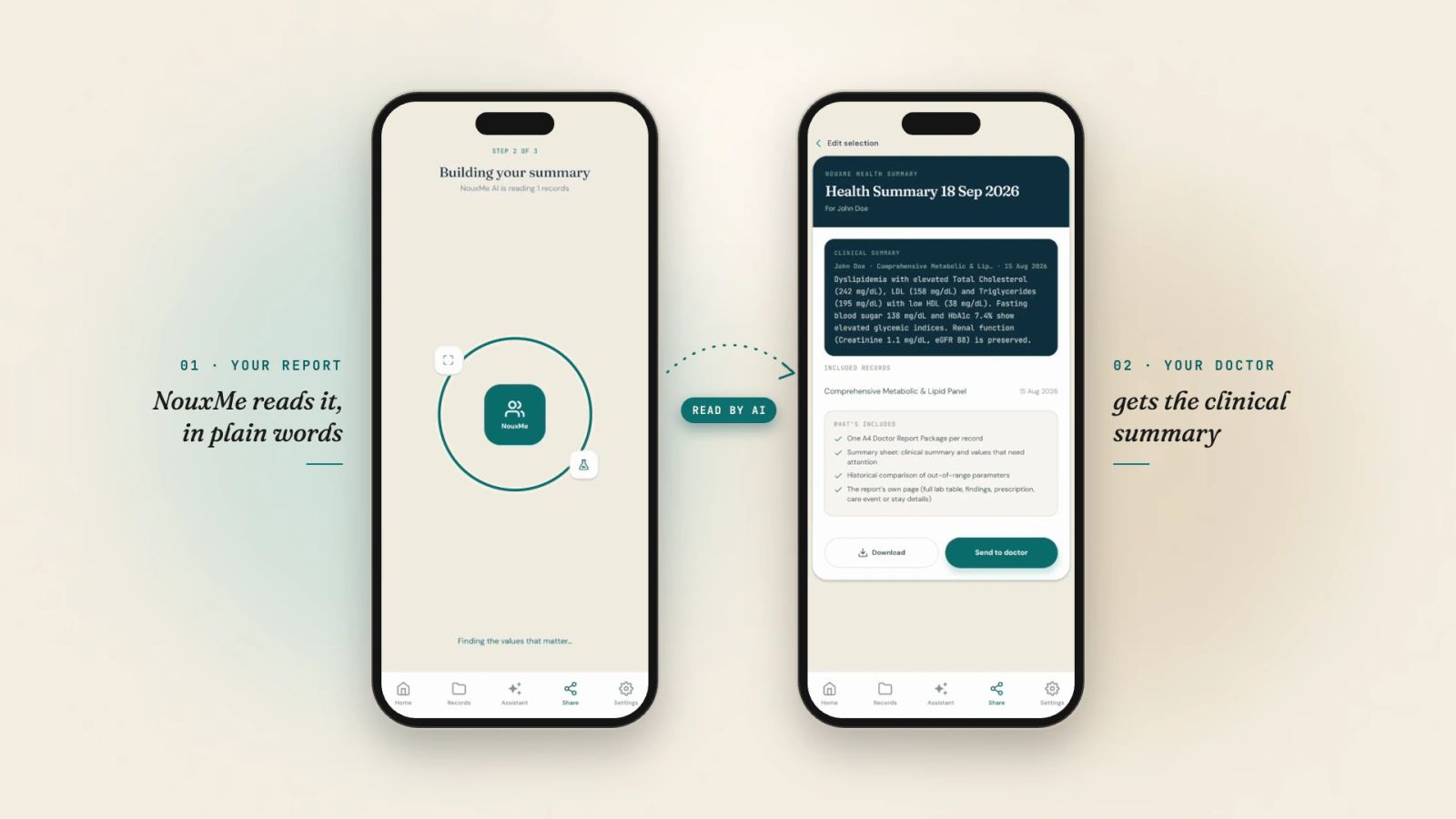
To understand a blood test report, read each result against the reference range printed beside it, then ask your doctor what it means for you. NouxMe, a personal health records app from NouxAI, reads each report and writes two summaries: one in plain language for you and one in clinical language for your doctor. It does not diagnose. NouxMe is in pilot on iOS, Android and the web.
It's 9:14 on a Tuesday night. Your phone buzzes. The lab has sent your blood report.
Two pages. Thirty-odd lines. Abbreviations you've never said out loud. And in the right-hand margin, next to one number, a small bold H.
Your appointment is on Friday.
So what do you do with that H for three days? Google it? Ask the family WhatsApp group? Decide it's nothing, then lie awake deciding it's something?
This post is about that gap, in numbers, and what we built NouxMe to do inside it.
Why is a blood test report so hard to read?
Because it was written for your doctor, not for you. A lab report is a list of test names, values, units and reference ranges, laid out for someone who reads hundreds of them a week.
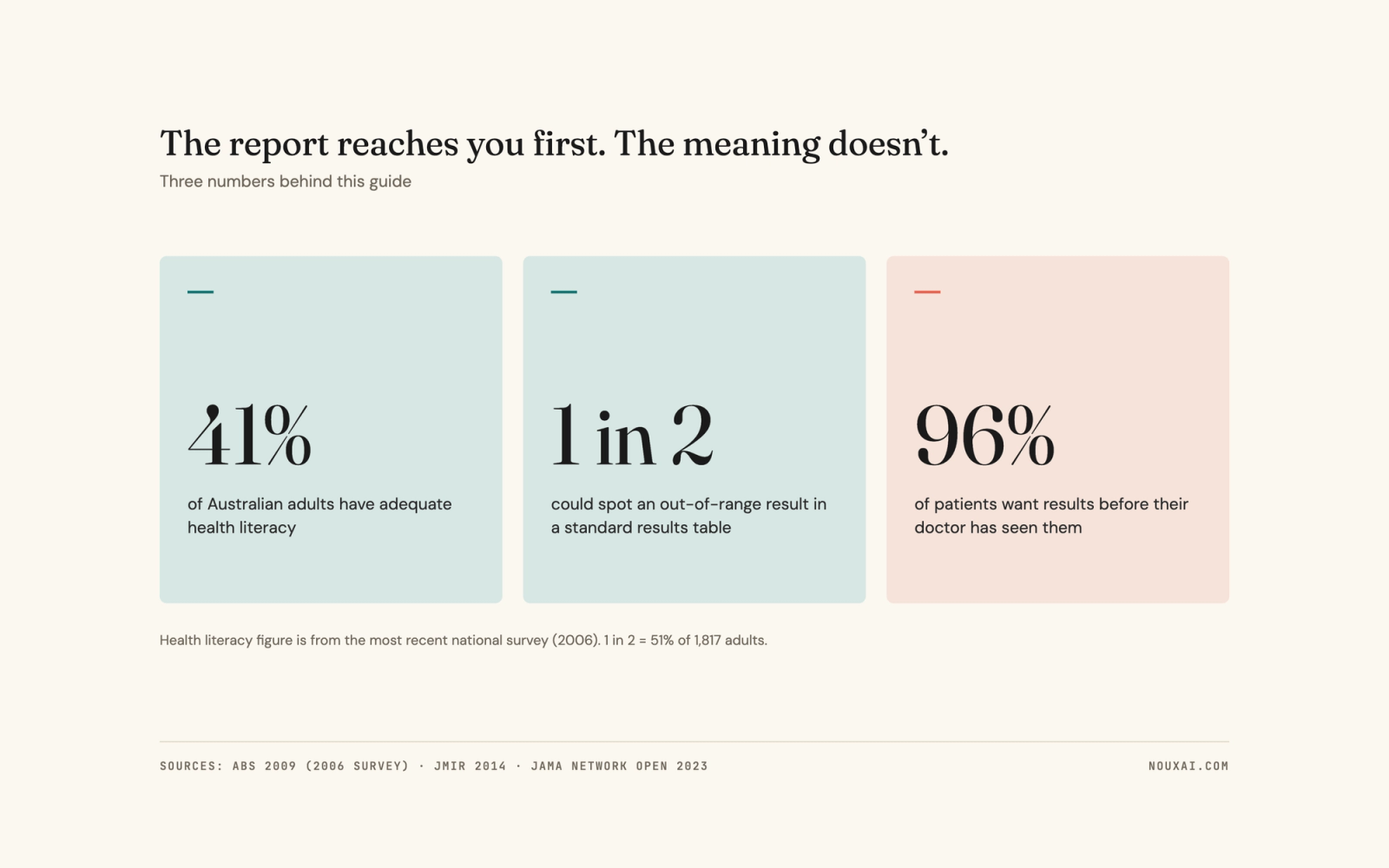
Most adults struggle with it. Australia last measured health literacy nationally in 2006. Only 41% of adults aged 15 to 74 scored at the adequate level, according to the ABS. Almost six in ten fell below it.
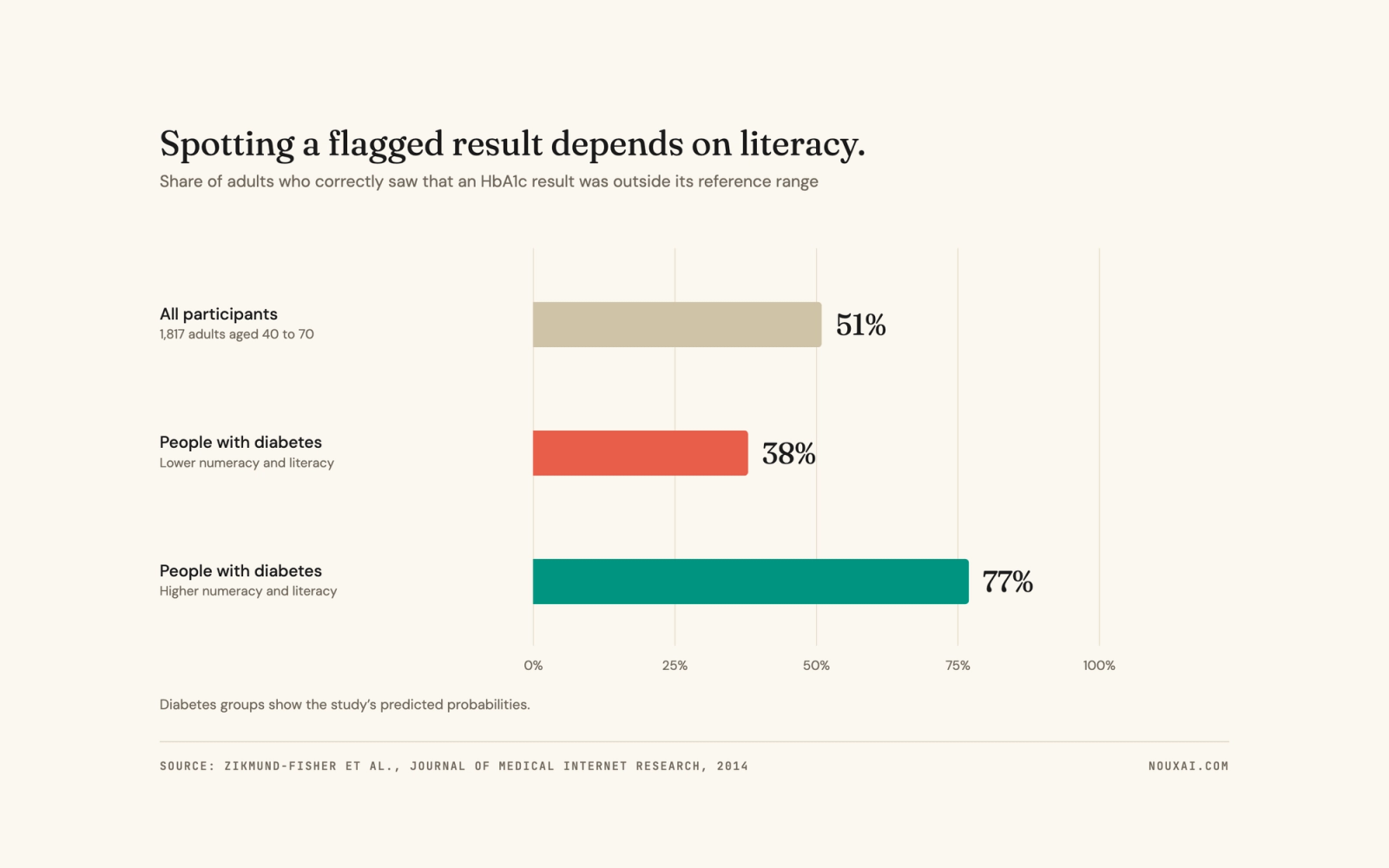
Even spotting a flagged value is hard. A 2014 study showed 1,817 adults a standard results table. Only about half could tell that the HbA1c result was outside its reference range. Among people with diabetes and lower numeracy and literacy, the predicted rate was 38%. With higher skills, it was 77%.
The report is accurate. It just isn't written for the person holding it.
And a flag on its own proves very little. Healthy people sometimes land outside a reference range, as MedlinePlus points out. The H is a question, not an answer.
Why do results reach you before your doctor does?
Because people want them that way. A 2023 survey in JAMA Network Open asked 8,139 patients when they wanted their results. 96% said as soon as they were ready, even before a clinician had reviewed them, BIDMC reported.
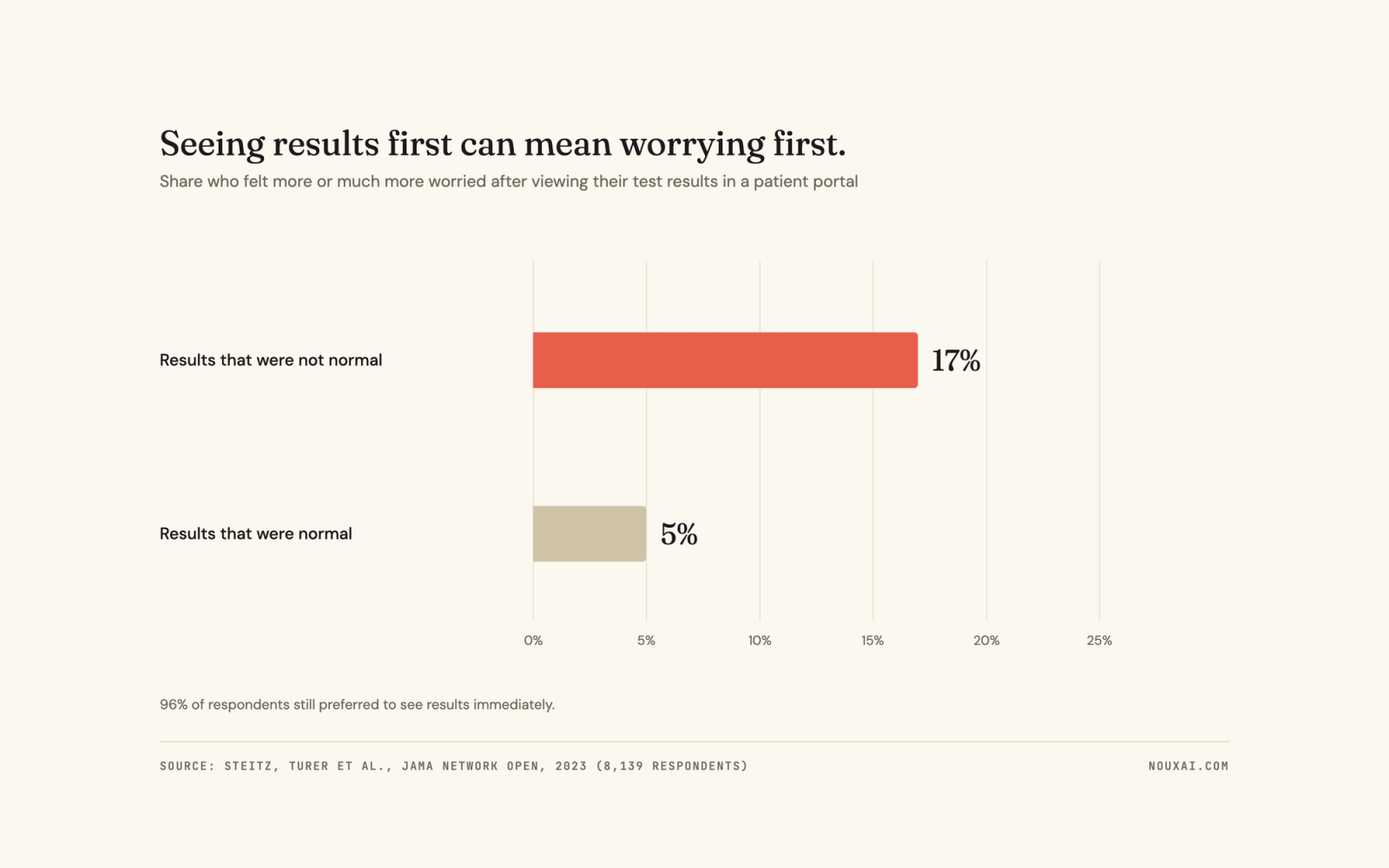
That speed has a cost. Of the people whose results were not normal, 17% felt more worried after seeing them. Among people with normal results, it was 5%.
So the report arrives first. The explanation arrives days later. The worry fills the space in between.
What does your doctor need from your report?
Speed. Your doctor needs the values that need attention, in clinical terms, without hunting through your phone gallery.
Consultation time is short almost everywhere. A review of 67 countries in BMJ Open found visits ranging from 48 seconds in Bangladesh to 22.5 minutes in Sweden. In 18 countries, covering about half the world's population, people get five minutes or less with their primary care doctor. In Australia it was just under 15 minutes.
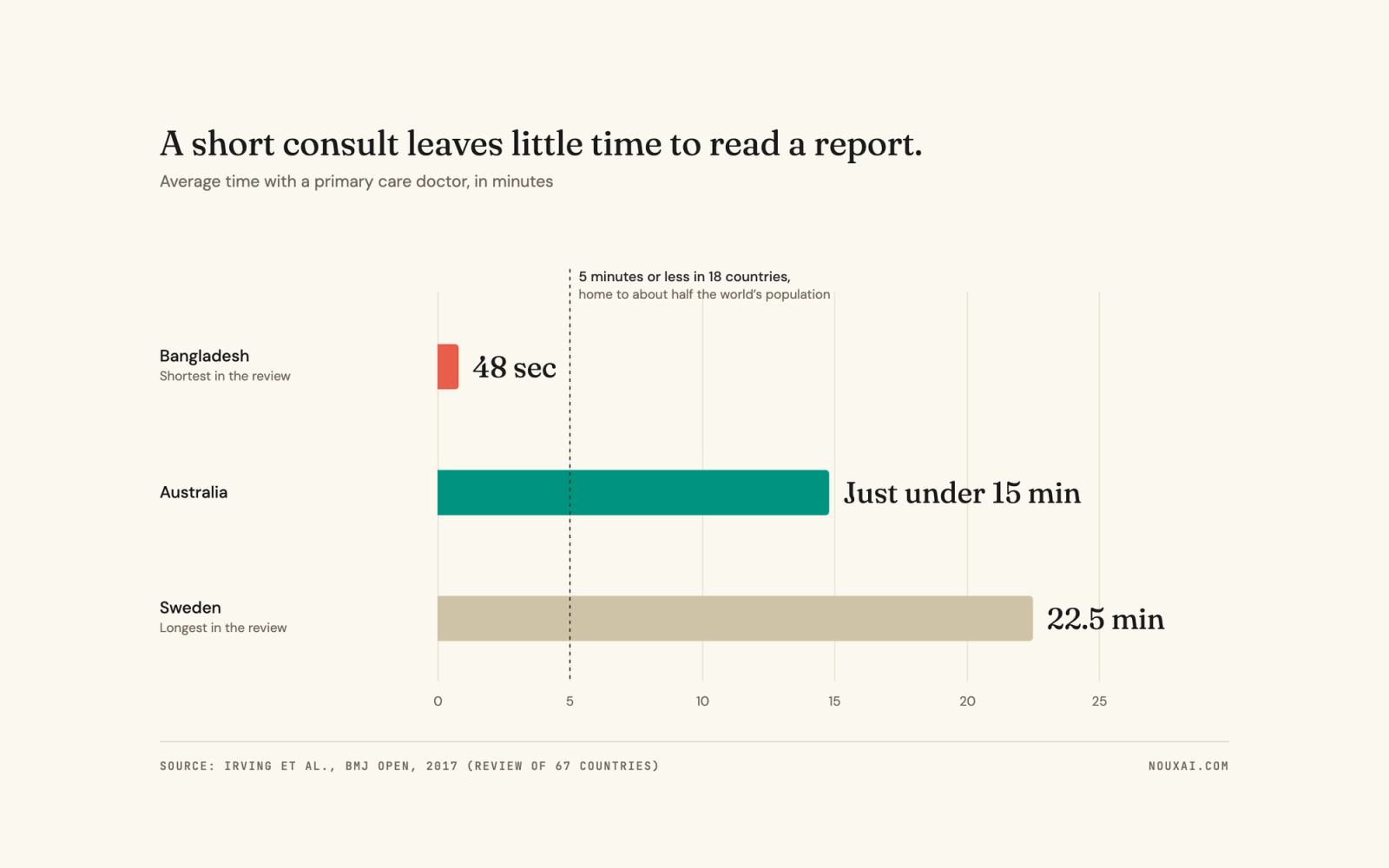
Five minutes is not enough time to rebuild a patient's history from loose pages. Every minute spent finding a report is a minute not spent on what it means.
How does NouxMe read one report for two readers?
NouxMe reads each report once and writes it twice: a plain-language summary for you and a clinical summary for your doctor. Here is how it works in the pilot.
- Add the report. Scan it with your camera or upload the PDF the lab sent.
- NouxMe reads it. The report is marked Read by AI, with your values pulled out and filed under the right test.
- You get plain language. A summary of what was tested and what the report says, in words you don't need to search for.
- Your doctor gets clinical language. The For your doctor view keeps the values, units and reference ranges a clinician expects.
- You see the trend. When the same test appears in more than one report, NouxMe lines the results up in a graph and a table.
- You send it. Pick the reports, tap Generate summary, and NouxMe builds a health summary you can download or send to your doctor's email.
| For you | For your doctor | |
|---|---|---|
| Language | Plain words | Clinical terms, values and units |
| What it highlights | What was tested and what the report says | Values that need attention, against each lab's own range |
| Across reports | Trends graph and table | Comparison of out-of-range values over time |
| Format | In the app, on your phone or the web | A health summary with one A4 page per report |
| The original | One tap away | Included in the summary |
The cover of this post shows the health summary your doctor receives. A clinical summary sits on top, then the values that need attention, a comparison with earlier results and each report's own page. Names and values in it come from our fictional demo record.
Can you trust AI to read your lab report?
Trust it to read and organise. Don't trust it, or any app, to decide what the result means for you.
AI has become good at explaining lab results in general terms. A 2024 evaluation tested AI on real patient questions about lab results. GPT-4's answers were rated more accurate, helpful, relevant and safe than answers from other people online. The same study found it sometimes gave inaccurate answers, or answers that weren't specific to the person asking.
That is why NouxMe is built with three limits:
- The original stays one tap away. Every summary links back to the report it came from, so a doctor can check the source.
- It answers from your records only. The NouxMe assistant works from the reports you have saved, not from the open internet.
- It never diagnoses. It doesn't predict an illness or suggest treatment, and every summary carries a reminder to verify it with your doctor.
What should you ask your doctor about your results?
Take three questions to the appointment, along with the report and the summary:
- What does this result mean for me, given my age, health and medicines?
- Has it changed since my last test, and does that change matter?
- Do I need treatment, a repeat test or nothing at all?
If you feel unwell, don't wait for Friday, or for an app. Call your doctor or your local emergency number.
What changes when the report has two readers?
Tuesday night looks different.
The report still arrives at 9:14. You still see the numbers first. But now there's a sentence beside them you can actually read. And there's a summary ready for Friday that your doctor can take in at a glance.
The H is still in the margin. It just isn't on its own anymore.
NouxMe is in pilot on iOS, Android and the web. You can request early access on the NouxMe page. To read why we built it, see The most valuable app on my phone.
Questions
How do I read a blood test report?
Find each test name, your result, the unit and the reference range printed beside it. Read your result against the range on your own report, because ranges differ between labs. Then ask your doctor what it means for you.
What does H or L mean on a blood test report?
H means your result is above the lab's reference range and L means it is below. A flagged result is not a diagnosis on its own, because healthy people sometimes fall outside a range. Ask your doctor what it means for you.
Can AI explain my blood test results?
Yes, AI can explain what a lab report says in plain language. It cannot tell you what the result means for your health. That needs your doctor, who knows your history, age and medicines.
Is it safe to use AI to understand my lab report?
It is safest when the AI only explains and organises, keeps the original report one tap away and leaves decisions to your doctor. NouxMe works this way and never diagnoses or recommends treatment.
What is NouxMe?
NouxMe is a personal health records app from NouxAI. You scan or upload your medical reports, keep them in one place, read a plain-language summary of each, and share them with your doctor.
How does NouxMe summarise a lab report?
NouxMe reads each report and writes two summaries: one in plain language for you and one in clinical language for your doctor. When the same test appears in more than one report, it shows the results in a graph and a table.
Can I send my lab results to my doctor from NouxMe?
Yes. Pick the reports, tap Generate summary, and download the health summary or send it to your doctor's email from the app.
What does my doctor receive?
A health summary with a clinical summary, the values that need attention, a comparison with earlier results and one A4 page for each report you chose.
Does NouxMe diagnose conditions?
No. NouxMe explains and organises your records. It does not diagnose, predict an illness or recommend treatment.
Can NouxMe compare results from different labs?
Yes. NouxMe lines up the same test across your reports, and shows each value against the range printed by the lab that tested it.
Why did my results arrive before my doctor saw them?
Many labs and portals release results as soon as they are ready. In a 2023 survey of 8,139 patients, 96% said they preferred it that way, even before a clinician had reviewed them.
Which devices does NouxMe work on?
NouxMe works on iOS, Android and the web. It is in pilot, and you can request early access on the NouxMe page at nouxai.com.
Sources
- Australian Bureau of Statistics: Health literacy, Australian Social Trends (cat. no. 4102.0), June 2009
- Zikmund-Fisher BJ, Exe NL, Witteman HO: Numeracy and Literacy Independently Predict Patients' Ability to Identify Out-of-Range Test Results, Journal of Medical Internet Research, 8 August 2014
- Beth Israel Deaconess Medical Center: Patients overwhelmingly prefer immediate access to test results (JAMA Network Open survey, Steitz, Turer et al.), 20 March 2023
- Irving G et al.: International variations in primary care physician consultation time: a systematic review of 67 countries, BMJ Open, 2017
- He Z et al.: Quality of Answers of Generative Large Language Models Versus Peer Users for Interpreting Laboratory Test Results for Lay Patients, Journal of Medical Internet Research, 17 April 2024
- MedlinePlus (US National Library of Medicine): How to Understand Your Lab Results, updated 4 September 2025